
If you run a paid community, you know the feeling. A good launch week, a wave of new members, and then a steady trickle of cancellation emails. Say you add 40 people and lose 25. Then you spend the next month trying to make up the difference.
Most coaches try to fix this with more content. Another course, another live call, another challenge. In my experience that rarely moves the number, because the problem usually isn't what's inside the community. It's what happens in the first few weeks after someone joins.
Where churn actually comes from
Membership platforms tend to describe churn in buckets. Uscreen's membership retention guide calls the first 30 days "activation churn" and treats it as the most critical period. That matches what I see. People rarely cancel because month eight was bad. They cancel because month one never clicked.
Someone who joins and doesn't find their footing in the first couple of weeks is quietly deciding whether to stay. They haven't posted, they haven't met anyone, and they haven't had a single win. When the second charge shows up, the easy answer is no.
What does good look like? There's no single benchmark, and averages hide a lot. Circle, the community platform, says on its member retention page that some of the top communities keep 90% or more of their members, while warning that it "isn't a copy paste benchmark." Passion.io, another platform, puts it this way: under 5% monthly churn is strong, and above 7% points to a structural problem. Both are vendors, so treat those as rough guides, not rules.
The five gaps I see most
- The welcome is a receipt. Someone pays, gets a login email, and lands in a feed of posts from people they don't know. Nobody tells them where to start.
- There's no first win. A new member should get a result in the first week. A finished workout, a plan, a first check-in, a reply from you. If the first win is weeks away, a lot of people won't wait for it.
- They never meet anyone. People join for the content and stay for the people. If nobody says hello in the first few days, the community is just a library with a monthly fee.
- Email stops at the receipt. The community lives on the platform, but the nudges that bring people back mostly live in email and push. Many coaches have a full nurture for leads and nothing at all for new members.
- Nobody's watching who goes quiet. By the time someone cancels, they checked out weeks ago. If you don't know who hasn't logged in for two weeks, you can't do anything about it.
What we did at RMR Training
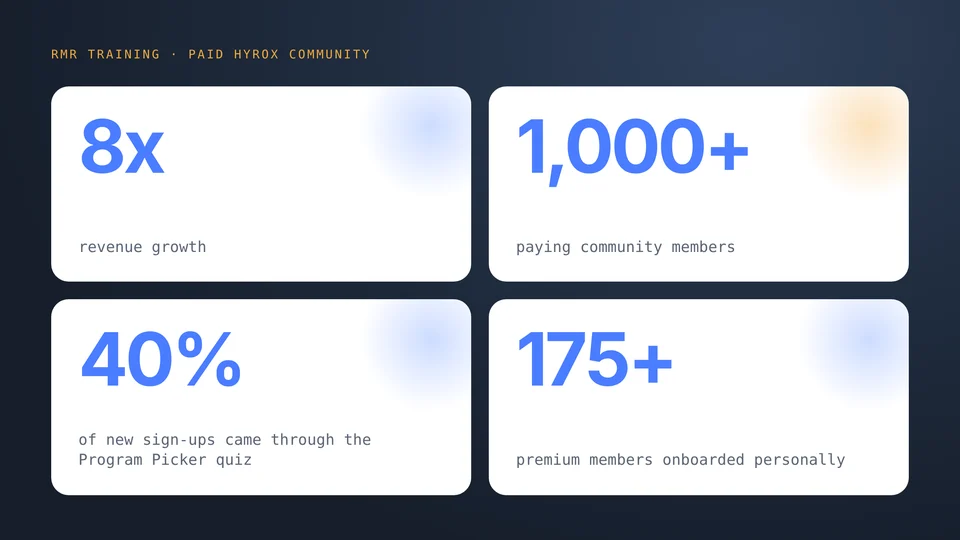
RMR is a HYROX coaching community that grew to more than 1,000 paying members at $50 a month. A lot of what made that work was boring, behind-the-scenes onboarding.
We moved the community onto a real platform, added a premium tier, and wrote email nurtures for each audience, including new members. On the premium side, I personally onboarded more than 175 members. That meant a real conversation with each one about their goals and how to get the most out of the program, not a form.
That last part doesn't scale forever, and it doesn't have to. What it does is teach you exactly what new members get stuck on, in their own words. Once you know that, you can build it into the system so everyone gets the benefit.
A simple 30-day onboarding system
Here's the version I'd build for most paid communities. It doesn't need fancy tools. Most community platforms and any decent email tool can handle it.
Day 0: a real welcome
- One clear "start here" post or page, not a menu of 12 options.
- A short welcome video from you, under two minutes.
- One action: introduce yourself in a specific thread, with a prompt that makes it easy ("Where are you training, and what's your next race?").
Days 1-7: get them a first win
- Point them to one starter piece of content and tell them why it's first.
- Reply personally to every introduction, or have a team member or a trusted member do it.
- Send three or four short emails: the first step, a member story, the next step, and an invite to the next live call.
Days 8-30: build the habit
- Give them a reason to come back weekly: a check-in thread, a weekly call, a monthly challenge.
- Connect them with two or three people at their level.
- At day 21 or so, ask one question: "How's it going so far?" The replies are gold, and the act of asking keeps people around.
Every week: watch who goes quiet
- Pull a list of new members who haven't logged in or posted in 14 days.
- Send a personal message, not a template. Ask what got in the way.
- When someone does cancel, ask why with a one-question exit survey. Read every answer.
What to track
You don't need a dashboard to start. Track three numbers each month:
| Number | What it tells you |
|---|---|
| Monthly churn (cancellations / members at the start of the month) | The overall health of the community |
| Churn in the first 30 days | Whether onboarding is working |
| % of new members who post or check in during week one | Your early warning signal |
If week-one activity goes up, first-month churn should follow it down a month or two later. That's the number to obsess over.
The takeaway
Most paid communities don't have a content problem. They have a first-month problem. Fix the welcome, get people a quick win, introduce them to each other and notice when they go quiet. Do that, and the members you already worked hard to get will actually stay.
Want help building this into your business?