
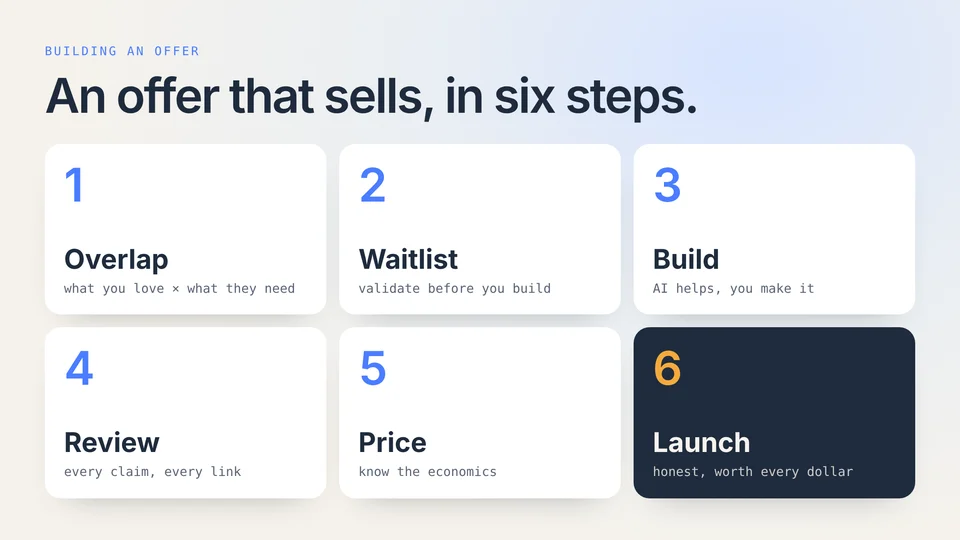
Most offers that flop weren't bad ideas. They were built in the wrong order. Someone picked a thing, spent months making it, slapped a price on it and hoped. Then they wondered why nobody bought.
An offer that sells is less about a clever idea and more about a process. Here's the one I use, with my own projects and with clients.
Start where what you love meets what they need
The best offers sit in the overlap between two lists.
The first list is what you genuinely care about. The stuff you'd talk about for free, the problems you can't stop thinking about, the work you'd still do on a bad day. If you build something you don't care about, it shows. You'll cut corners, you'll dread marketing it, and your audience will feel that.
The second list is what your audience actually wants. Not what you think they should want. Read their comments and DMs. Look at the questions they ask over and over. Ask them directly what they're stuck on.
Where those two lists overlap is your offer. That's where you get to be authentic and useful at the same time, and that combination is what people pay for.
Validate it before you build it
Once you have an idea, don't build it yet. Build a waitlist first.
A simple page, one clear promise, one form. Decide ahead of time how many sign-ups count as a yes, then put real effort into filling it for a few weeks. If you hit the number, you build with confidence. If you don't, you go back to the overlap and try again.
This step saves more time and money than anything else on this list.
Use AI to help, not to make the thing
I use AI every day. It's great for research, for organizing your thinking, for a first outline, for proofreading, for getting unstuck on a blank page.
But it shouldn't make the offer for you. People can tell when something was generated instead of made, and the moment they notice, trust goes with it. An offer built mostly by AI tends to sound like everyone else's, because it's working from the same average as everyone else's.
Your experience, your examples, your opinions and your voice are the product. Let AI speed up the work around them. Don't let it replace them.
Review it like your reputation depends on it
It does.
Before anything goes out, go through it slowly. Then have someone else go through it too, ideally someone who fits the audience. Check every claim. Click every link. Read it on your phone. Ask: is anything confusing, outdated, or promising something it doesn't deliver?
This matters even more if AI helped along the way. AI is often confidently wrong, and a single wrong fact or broken step can undo the trust the rest of the offer earned. The review isn't the boring last step. It's what turns a draft into something you're proud to charge for.
It should never feel like a money grab
People can smell a cash grab from a mile away: thin content stretched to fill a price, fake urgency, a countdown timer that resets every time you refresh, a pitch that's bigger than the product.
The fix is simple. Make the thing genuinely good, then sell it honestly. Say clearly who it's for and who it's not for. Use real deadlines and real limits, or none at all. Make the free version of your work valuable too, so people already know what you're capable of before they ever pay you.
If your offer is good, you don't need tricks. If it needs tricks, it isn't ready.
Make it feel worth the price
People judge quality by the details. The design, the writing, how easy it is to start, how fast you respond when someone has a question. A great offer feels polished from the sales page to the last lesson.
Ask yourself one question: if a friend paid for this, would I feel good about it? If the answer is anything but an easy yes, keep working on it.
Know the economics behind it
This is the part creators skip most often. Before you set a price, understand the numbers:
- What does it cost you to deliver? Your time, tools, platform fees, payment fees, support.
- What does it cost to get a buyer? Ads, content, the hours you spend selling.
- How many do you need to sell for it to be worth your time?
- What happens next? Does this offer lead to another one, so a buyer is worth more than one sale?
An offer can sell well and still lose you money if you never ran the numbers. And an offer that looks expensive can be a great deal once you see what it replaces, like a year of trial and error or one-on-one help that costs ten times as much. Know your numbers, and you'll price with confidence instead of guessing.
Putting it together
- Find the overlap between what you love and what your audience needs.
- Validate it with a waitlist before you build.
- Use AI to move faster, but make the thing yourself.
- Review it thoroughly, and get a second set of eyes.
- Sell it honestly. No tricks, no money grab.
- Make it feel worth every dollar, and know the economics behind the price.
Do it in that order and your next offer has a much better chance of selling, and of being something you're proud of.
If you want help working through yours, book a free call.
Want help building this into your business?